A wall that holds forty caps
Caps, sunglasses, necklaces and ties all fail storage in the same way: stacked flat they lose their shape, and out of sight they stop being worn. Hanging is not tidiness. It is retrieval.
There is a chair in the bedroom, and the chair is not a chair any more. It holds four caps, two pairs of sunglasses, a tie that was worn once in March, and a hair clip that has sat in the same place so long it has started to look deliberate.
None of that is there because you are disorganized. It is there because every alternative on offer is worse. Stack the caps and the brims go flat. Put the sunglasses in a drawer and they come out scratched. The chair wins because the chair keeps everything where you can see it, and the things you can see are the things you wear.
What flat storage costs, and when the bill arrives
The cost is invisible on the day you put something away. It shows up weeks later as a flattened brim, a scratched lens, a crease that will not fall out, and a necklace that has knotted itself around two others.
The pattern is the same across the whole pile: rigid things are asked to lie flat, and soft things are asked to hold still. A cap is a curve. A lens is a fragile plane. A necklace is a line that wants to tangle. A tie is a rectangle that remembers every fold. A drawer treats all four the same way, which is to say it treats none of them correctly.
| Kind of thing | What it needs | What happens flat or in a drawer |
|---|---|---|
| Structured caps | Room to keep the brim curve without compression | The lower caps carry the weight of the ones above and the curve goes |
| Sunglasses | Lenses that touch nothing else | They move against each other. The scratches are on the lens and are permanent |
| Necklaces | To hang and be left hanging | Laid flat and then moved, they knot |
| Ties | To hang at full length | A crease forms along the fold and has no reason to leave |
| Hair clips | To be told apart at a glance | They are identical, so the problem is finding one, not storing it |
Hair clips are the odd one out. They do not crease or scratch or compress. They simply disappear into each other, and a drawer of identical small objects is a drawer full of delay: you open it, you see a texture rather than a set of things, and you use the same two clips for a year.
Ties fail the most gradually. Fold one for a weekend and the mark falls out in a day. Fold it for a month and the mark is the new shape of the fabric.
A wall does not compress anything
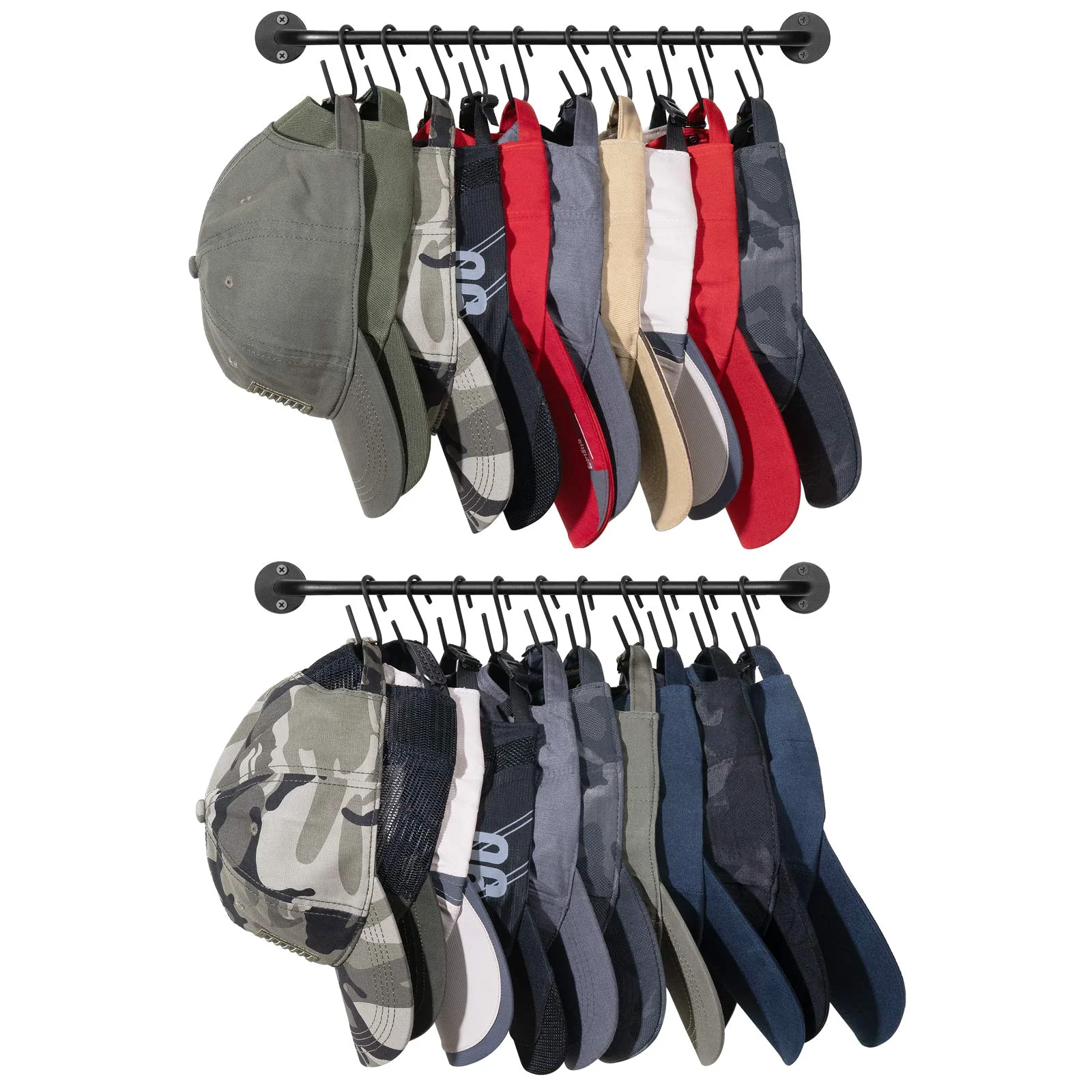
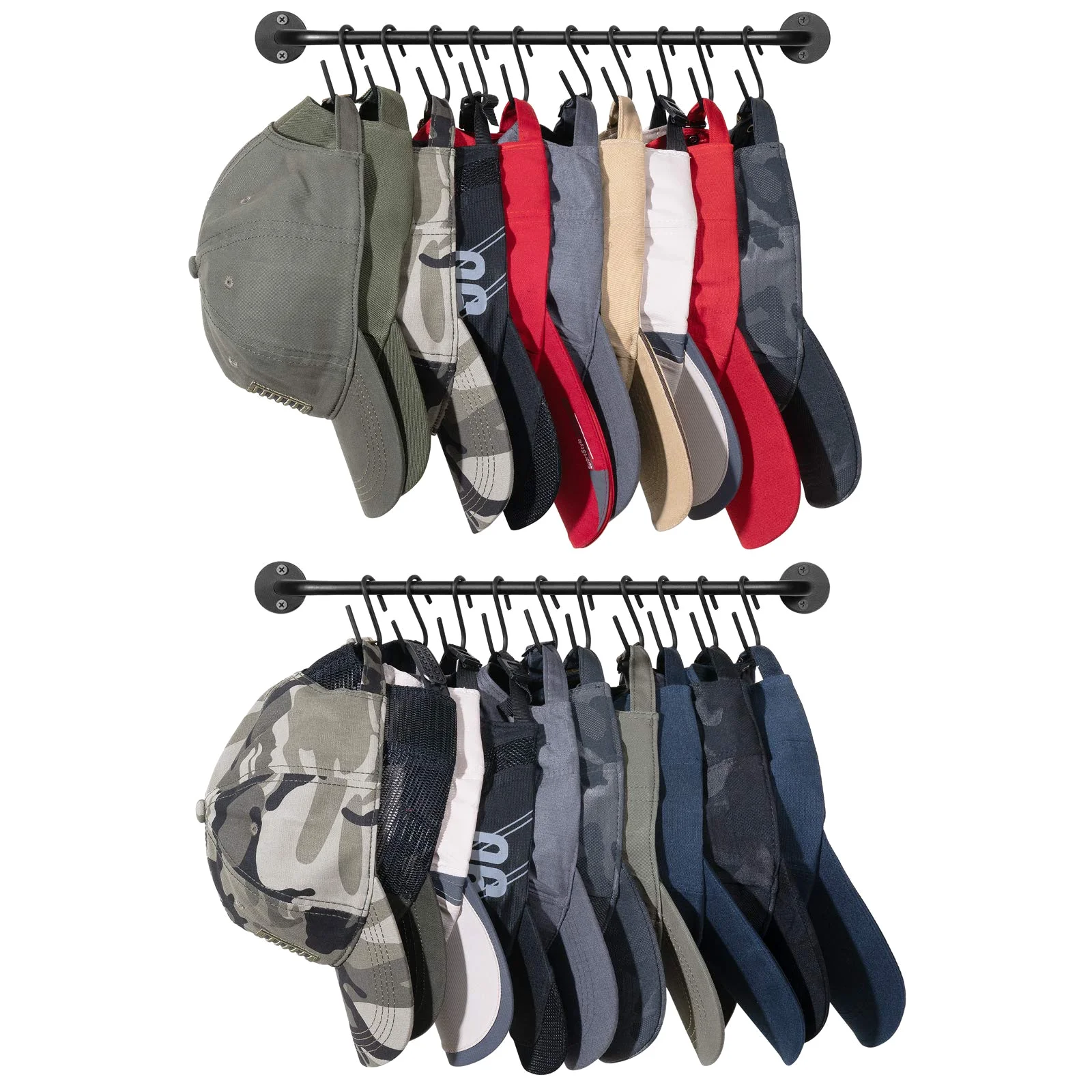
A rail takes the pile apart. Each cap hangs by its brim or its closure, parallel to the wall, carrying only itself. Nothing presses on the curve, so the curve stays.
Rails in this catalog come at twenty, twenty-four, thirty and forty caps, in sets of two and four, which means capacity grows by adding a rail rather than by starting a second layer. That distinction matters more than it sounds. A second layer on a shelf is a layer you forget. A second rail mounted higher is still in the eye line, and the hand follows the eye without being asked.
Fixing it up is the part worth doing properly. Studs in US framing usually sit sixteen inches apart, sometimes twenty-four, and drywall on its own holds close to nothing, so a rated anchor does the carrying wherever a stud does not. The federal safety commission tells people to anchor furniture with drawers, doors or shelves to the wall, and a federal stability rule for clothing storage units took effect on 1 September 2023. A rail has no drawers and no doors. It is anchored by construction, which is the whole reason it does not sway when you lift a cap off the end.
Super easy to install, with a clean and organized look. Finally, most of my hats have their own place. It’s very durable and stable, with plenty of hooks to hang my hats.
That is from May, about the twenty-hook rails. The phrase to notice is "their own place", because that is what a rail buys: not tidiness, but an address for each thing.
A hook is a pause button
Hanging something stops the clock on it. A tie on a hook is a tie that has not been folded. A necklace on a peg is a necklace that has not knotted. A bracelet on a stand is a bracelet waiting for a wrist rather than a chain waiting for a bad afternoon.
The tools for that are all shaped by the same reasoning. A jewelry tree with twenty-two hooks lets a chain drape in a single line, so gravity does the untangling before a knot has anywhere to form. A bracelet stand with forty or sixty hooks turns a heap into a row you can read. A tiered stand puts the back row higher rather than behind, so you can see it without lifting the front. A tie rack with twenty rotating hooks holds each tie at full length and spins the one you want to the front.
Sunglasses want the same thing for a different reason. Held by the bridge or an arm, with the lenses facing out, they touch nothing, and touching nothing is the entire job. A stand for one pair and a stand for twelve solve exactly the same problem at different scales.
Small identical things need separation rather than containment. A claw clip holder does not hold sixteen clips so much as give each of them a position, and a scrunchie stand does the same for twenty or thirty fabric rings. You stop digging and start choosing, which is a different action with a different cost.
Count the caps before you buy the rail
The order most people use is backwards. They buy a rail, put it up, hang what fits, and put the rest back on the chair. Do it the other way round and the whole job takes one afternoon instead of three.
Start by taking everything off the chair and the shelf and counting it. Not estimating: counting. The number is almost always higher than the guess, because the pile has been absorbing things for a year and a half. Then decide what you actually wear, because a rail full of caps you have not touched since 2023 is a display case, not storage.
Now measure the wall. A rail wants a horizontal run clear of the door swing, the light switch and the curtain, and it wants at least one fixing into a stud. Studs sit sixteen inches apart in most US framing and sometimes twenty-four, so a run of two feet almost always crosses one and a run of eight inches might not. Mark the stud first and place the rail around it rather than the other way round.
Then buy on capacity with a little room to spare. Rails come at twenty, twenty-four, thirty and forty, in sets of two and four, and the honest arithmetic is that a collection grows. A rail bought to fit exactly what you own today is a rail you will be adding to by spring.
Height is the last decision and the one people get wrong. Hang the top rail where you can lift a cap off without reaching, not where the wall looks balanced. A rail you need a chair for is a rail you will stop using, and the chair, you will remember, is what this was about.
The back of the closet door is air you already own
There is one wall in most bedrooms that does nothing at all. When the door is shut it faces the room. When it is open it hides against the jamb. Either way it is a flat surface that has never been asked to work.
A rail there costs no floor and no room wall. It is in front of you at the moment you are standing at the closet deciding what to wear, which is the only moment it needs to be. The door swings. The rail does not swing with it, and the caps ride against the surface in their hooks.
It is also the answer for anyone with one wall and a landlord who reads it closely. A door is a smaller commitment than plaster.
The catch is weight, and it is worth saying out loud. A door is a hollow panel on three hinges, and it swings. Caps are the right load for it: two dozen of them weigh less than a coat. A rail of that door loaded with bags or boots is a different proposition, and the hinges will tell you about it in about a month, first as a rub against the frame and then as a door that no longer shuts square.
So the sorting goes roughly this way. Light and flat things that you choose from every morning go on the door, where you see them at the moment of choosing. Anything with real weight goes on a wall, into a stud. And whatever you touch twice a year goes in the box on the top shelf, which is the one place in this whole article where hiding something is the correct answer.
The ninety seconds before you leave
The test of a storage system is not how the room looks when it is clean. It is what happens in the ninety seconds before someone walks out of the house, when the car is running and the mind is already at the other end of the journey.
In those ninety seconds you want a cap, the sunglasses, a tie, a clip. What you do not want is a project. On a rail you see the color you want and lift it by the brim, and the curve is where you left it. On a stand the arms are open and the lenses are clear. On a rotating rack you spin, choose, and the silk hangs straight. On a tree the necklace drapes over your hand in one line.
None of that is tidiness. It is retrieval, which is the only thing storage was ever for. The chair goes back to being a chair, the drawer keeps the things that genuinely do not mind lying flat, and the Mkono studio will happily sell you the rails and stands that do the rest. If the wall you are eyeing is going to carry a plant as well, there is a piece about that.
One click away
Every price on this page is live at our retail partner, and every button opens the piece it sits under. Take the whole shelf at once, or go back up and take one thing.